Granby sits on the St. Lawrence Lowlands, where Pleistocene glaciation left behind thick sequences of coarse glaciofluvial sands and outwash gravels. These deposits can reach depths of 20 meters or more across the Yamaska River plain, and their loose-to-medium relative density creates a direct challenge for settlement control under structural loads. The water table in much of the Granby industrial corridor sits within 2 to 3 meters of the surface, which complicates shallow foundation alternatives on compressible granular layers. A properly engineered vibrocompaction program raises the relative density in-place, reducing post-construction settlement without importing fill or excavating to depth. Our team combines site-specific liquefaction screening per NBCC 2020 with CPT testing to pre-qualify soil responsiveness, and we frequently integrate grain-size analysis to confirm that fines content remains below the threshold where vibratory methods lose efficiency.
A well-designed vibrocompaction grid can move a NBCC Site Class D profile into Class C territory, directly reducing seismic base shear demands on the structure.
Methodology applied in Granby Quebec
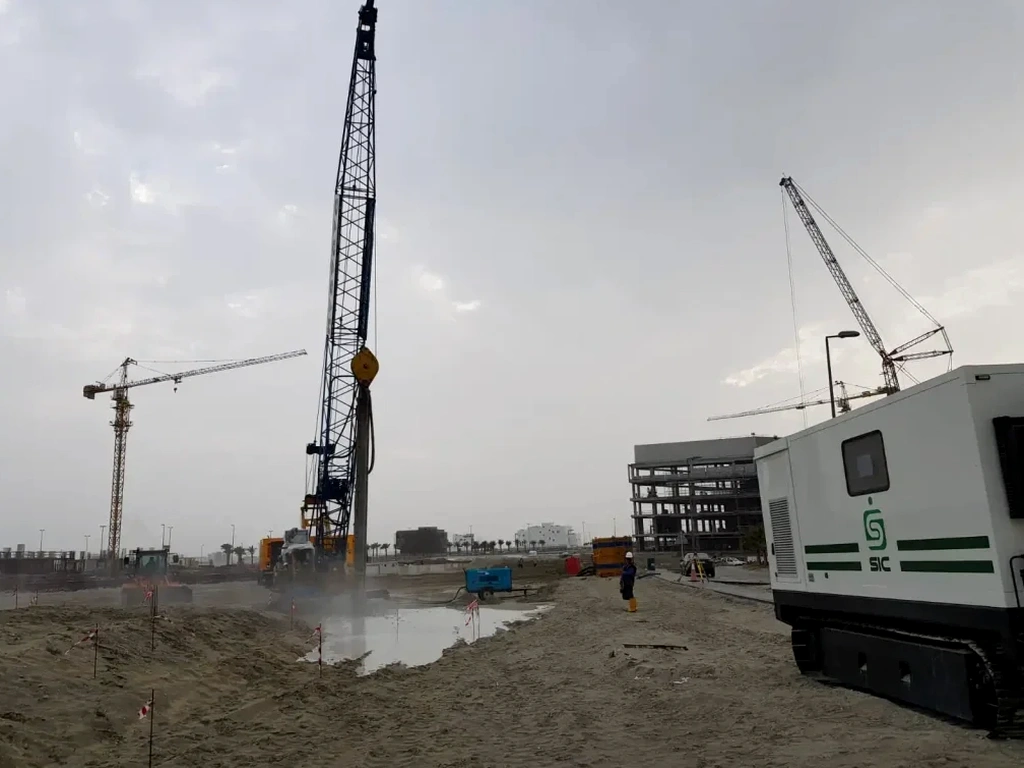
Risks and considerations in Granby Quebec
The most expensive mistake we see in Granby is ordering a vibrocompaction program without first mapping the fines distribution across the site. Glaciofluvial deposits here are layered — a clean sand stratum can pinch out laterally into a silty sand lens within 30 meters, and those transitional zones barely respond to vibration alone. The result is differential densification: some zones tighten to a dense state while adjacent areas stay loose, creating a stiffness contrast that attracts stress under shallow footings and can tilt a slab or rack a steel frame. We address this by running a dense CPT grid before design, classifying soil behavior type with Robertson's SBT charts, and flagging any interval where Ic exceeds 2.6. Those pockets get a secondary treatment — either a reduced spacing or a switch to bottom-feed stone columns — so the entire building footprint settles uniformly. Skipping that step has led to floor cracking within the first three years on more than one Granby commercial project.
Our services
Our vibrocompaction design package for Granby projects follows a three-phase delivery model that moves from site characterization through field execution to performance verification.
Pre-Treatment Site Characterization & Responsiveness Trial
We execute a CPT and grain-size campaign to map fines content, soil behavior type, and pre-treatment relative density across the footprint. A trial compaction grid on the actual material confirms probe spacing, vibration dwell time, and water jetting pressure before production begins.
Production Vibrocompaction Design & Field Oversight
Design deliverable includes grid layout, probe penetration depth, sequence of passes, and real-time quality control parameters. Our engineers monitor energy consumption, probe amperage, and crater settlement during production to verify conformance with the densification curve.
Post-Treatment Verification & Seismic Site Class Update
We run a second CPT campaign on a staggered grid and execute cross-hole shear wave tests to measure Vs,30 improvement. Final report includes updated NBCC Site Class classification and settlement estimates under service loads, signed by a Quebec-registered geotechnical engineer.
Frequently asked questions
What soil conditions in Granby are best suited for vibrocompaction?
The most responsive materials are the clean glaciofluvial sands and gravelly sands common along the Yamaska River plain. Fines content should stay below 12 to 15 percent for efficient vibration transmission. Silty sands with intermittent silt lenses can still be treated but require closer probe spacing and careful CPT verification to confirm that the target density is reached uniformly.
How long does a vibrocompaction program take for a typical Granby commercial lot?
For a 2,000-square-meter commercial footprint with treatment to 12-meter depth, the field work — including trial grid, production passes, and post-treatment CPT — typically spans 8 to 14 working days. Mobilization of the vibroflot rig and water supply can add two days at each end. Site access constraints along Rue Principale or near the Autoroute 10 frontage sometimes extend the schedule slightly.
What is the typical cost range for vibrocompaction design and verification in Granby?
The geotechnical design package — including pre-treatment CPT, trial grid analysis, production design, and post-treatment verification — generally falls between CA$1,790 and CA$8,150, depending on the treated area, depth, and number of verification soundings. The vibroflot contractor's mobilization and production rates are separate and quoted directly by the specialty subcontractor.
Can vibrocompaction eliminate liquefaction risk under the NBCC seismic hazard for Granby?
Yes, when the post-treatment verification confirms that the sand reaches a relative density above 70 percent, with (N1)60 values exceeding 20 and Vs,30 above 200 m/s, the deposit qualifies as NBCC Site Class C or better. At that density, the excess pore pressure generation under the 0.25g design shaking level is suppressed enough to rule out flow liquefaction in clean sands. Silty pockets need separate evaluation.