Granby sits on post-glacial Champlain Sea deposits—sensitive silty clays that complicate any excavation deeper than 3 meters. The groundwater table across the Yamaska River plain often sits within 2 meters of the surface, and the clay's remoulded strength drops fast once exposed to vibration or water. Our team works with this stratigraphy directly, designing shoring and dewatering systems that account for the real behavior of these soils. For projects near the downtown core or along Rue Principale, we combine the excavation design with a slope stability analysis to confirm that adjacent structures stay protected during the cut. Where the clay layer is thinner and bedrock approaches within 5 meters, the anchor system design becomes critical for lateral support in tight urban footprints.
Sensitive clay in Granby loses up to 80% of its undisturbed strength when remoulded—shoring design here is about controlling deformation before it starts.
Methodology applied in Granby Quebec
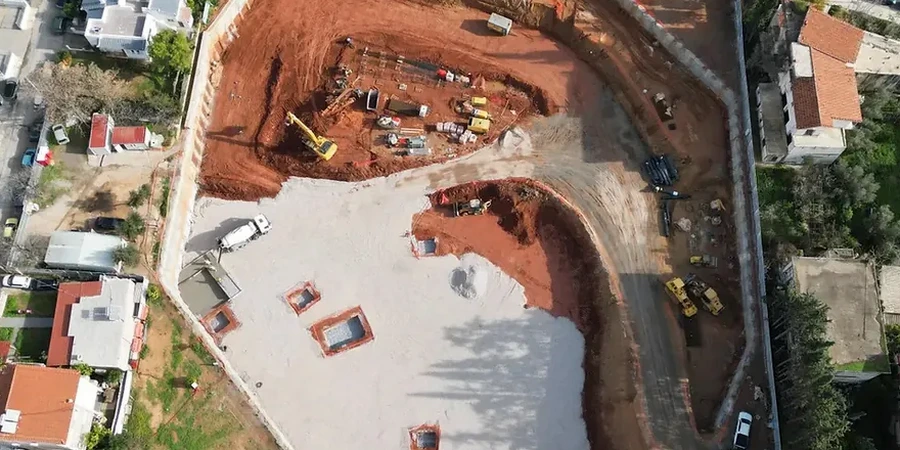
Risks and considerations in Granby Quebec
In Granby, the most common surprise we see during excavation is the encounter with isolated sand lenses within the clay matrix. These pockets carry perched groundwater that can cause sudden inflow into the cut, softening the exposed clay face and triggering local sloughing. Another risk is underestimating the long-term consolidation settlement behind shoring walls—the drawdown from dewatering can extend well beyond the excavation footprint, affecting shallow foundations on neighboring properties. We address this with detailed hydrogeological characterization before the first shovel hits the ground, including piezometer installations to map the phreatic surface seasonally. For cuts deeper than 6 meters, we also evaluate basal heave potential using Bjerrum and Eide's method, adjusting the excavation sequence to maintain a safe factor of safety against bottom instability.
Our services
We provide two core service configurations for deep excavations in Granby, tailored to site constraints and ground conditions.
Shoring and Earth Retention Design
Design of soldier pile walls, secant pile walls, and anchored systems for cuts up to 15 meters. Includes lateral earth pressure calculations, tieback spacing optimization, and deflection analysis using beam-on-elastic-foundation or finite element models.
Dewatering and Groundwater Control
Design of deep well, wellpoint, or eductor dewatering systems for excavations below the water table. Includes pumping test analysis, drawdown radius estimation, and settlement assessment for adjacent structures.
Quick answers
How much does a deep excavation design cost in Granby?
Do I need a dewatering permit for excavation in Granby?
Yes. The Ville de Granby requires a permit for any dewatering discharge to the municipal storm sewer. You will also need approval from the Ministère de l'Environnement (MELCCFP) if the pumped volume exceeds 75 m³ per day or if the water quality does not meet discharge criteria.
What shoring system works best in Granby's sensitive clay?
Soldier pile and lagging with tiebacks is common for cuts under 8 meters where the clay has a stiff crust. For deeper excavations or where groundwater is high, secant pile walls provide better water cutoff. In extremely soft clay near the river, we sometimes specify jet grout bottom plugs to control basal heave.
How long does the design phase take?
A complete geotechnical design package—including site investigation review, earth pressure calculations, shoring wall structural design, and construction sequence—typically takes 3 to 5 weeks. Projects requiring 3D finite element analysis or staged excavation modeling may need additional time.
Can you design excavation support next to existing buildings?
Yes. We conduct pre-construction condition surveys of adjacent structures, set deflection criteria based on building tolerance, and design the shoring to limit ground movement. For sensitive heritage buildings in downtown Granby, we often specify inclinometer monitoring and vibration limits during installation.