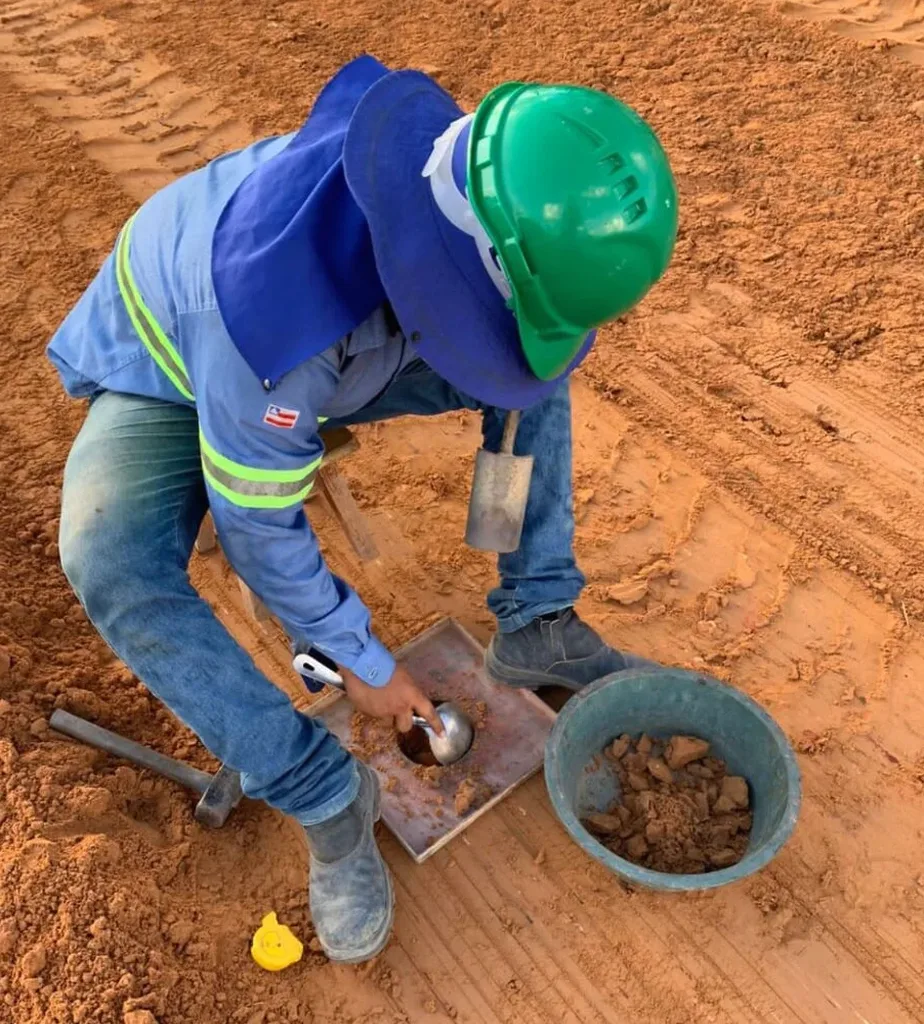
The sand cone apparatus we deploy in Granby consists of a one-gallon plastic jar, a precision metal cone with a cylindrical valve, and calibrated Ottawa sand graded C-109. The valve controls flow into the excavated hole. In Granby’s glacial till and Champlain Sea clay deposits, moisture content shifts fast—spring thaw saturates the upper 600 mm, while August heat bakes it dry. We run the ASTM D1556 procedure on-site, weighing sand before and after filling the test cavity. The standard 165 mm diameter base plate sits flush on compacted lifts. For granular subbases along Boulevard David-Bouchard, we often pair density checks with a Proctor curve to establish the reference maximum dry density. In utility trenches crossing the Yamaska River floodplain, the moisture correction becomes critical for accurate compaction ratios.
In Granby’s Champlain Sea silts, a 2 percent moisture swing can shift the sand cone density reading by over 80 kg/m³ — enough to fail a compacted lift that a nuclear gauge would pass.
Methodology applied in Granby Quebec
Risks and considerations in Granby Quebec
NBCC Division B Part 4 requires 95 percent standard Proctor density for structural fill under footings in seismic design category C and D—which applies to much of Granby given the moderate seismicity of the Eastern Townships. Skipping sand cone verification on a compacted clay liner beneath a stormwater pond, for example, leads to differential settlement when the clay consolidates unevenly. We have seen trench reinstatements along Rue Principale settle 40 mm in 18 months because the backfill was accepted on visual observation alone. The sand cone test gives a verifiable number—wet density, dry density, and percent compaction relative to the lab Proctor. In cohesive Champlain Sea deposits, the test must run within 30 minutes of excavation or the hole walls dry and crumble, inflating the sand volume. That false reading can mask a 5 to 8 percent compaction deficit.
Our services
Our field density services in Granby cover the full QA/QC chain from lab Proctor reference to in-place sand cone verification. Each service runs under our ISO 17025-accredited laboratory program, with calibrated equipment traceable to NRC standards.
Standard Proctor Reference (ASTM D698)
Laboratory compaction curve using 2.5 kg rammer, 305 mm drop, three-point curve for compacted fill specification. Required before any sand cone correlation.
Field Sand Cone Density (ASTM D1556)
On-site density test with calibrated Ottawa sand, moisture sample, and real-time percent compaction calculation. Covers structural fill, trench backfill, and pavement subgrade.
Trench Backfill Acceptance Package
Sequential sand cone testing per lift in utility and sewer trenches, with stamped reports referencing NBCC compaction thresholds and CSA A23.3 subgrade requirements.
Pavement Subgrade QA/QC
Density and moisture control on granular subbase and subgrade layers prior to asphalt or concrete paving, correlated with CBR and Proctor data for Granby’s freeze-thaw conditions.
Frequently asked questions
How much does a sand cone density test cost in Granby?
A single ASTM D1556 sand cone test in Granby ranges from CA$140 to CA$180, which includes the field test, moisture content determination, and the percent compaction report referenced to the lab Proctor curve. Mobilization is priced separately based on site location within the Granby area.
What is the difference between the sand cone test and a nuclear density gauge?
The sand cone gives a direct measurement of soil density by volume displacement—no calibration to local soil chemistry is needed. Nuclear gauges require site-specific calibration curves and can give skewed readings in Champlain Sea clays with high iron or organic content. The sand cone is slower but is the referee method when nuclear gauge results are contested.
How many sand cone tests are needed per lift in Granby?
NBCC Table 4.2.4.3 calls for one field density test per 500 square meters per compacted lift, with a minimum of one test per lift per lot. For narrow trench backfill, we test every 300 mm of lift depth along the trench alignment, typically one test per 15 linear meters.
What moisture conditions affect sand cone results in Granby’s soils?
Granby’s Champlain Sea silts and clays are sensitive to moisture. If the test hole is left open longer than 30 minutes in dry summer conditions, the walls desiccate and crumble, inflating the sand volume and underestimating density. In wet spring conditions, free water can seep into the cavity and contaminate the sand, requiring a retest.