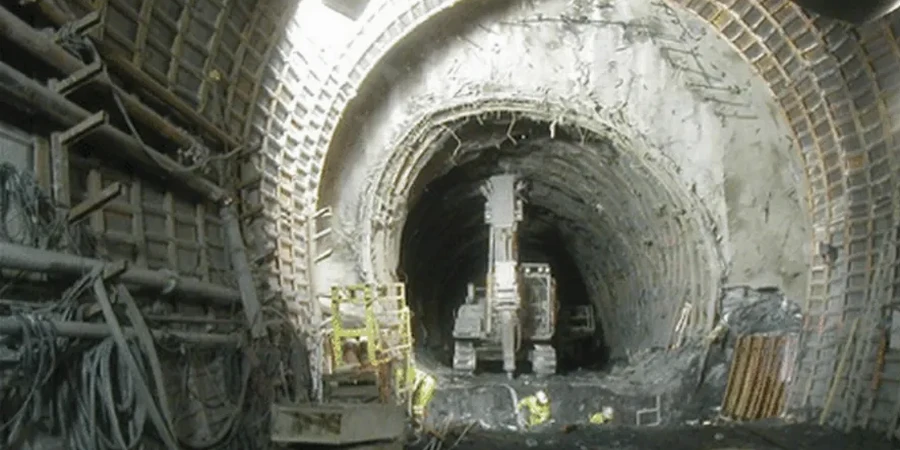
Driving a tunnel beneath the Yamaska River floodplain is a world apart from boring through the compact glacial till you find upslope near the Granby Zoo. The contrast within a few kilometers of Granby is stark--what starts as manageable silty sand can quickly turn into a saturated, sensitive clay that loses strength the moment it's disturbed. This is the legacy of the Champlain Sea, and it defines every underground project in the region. Crews unfamiliar with the rapid transition from lodgement till to Leda clay get caught off guard. We've seen it happen. The grain-size analysis combined with Atterberg limits becomes essential here to distinguish a workable face from a flowing ground condition before the TBM ever fires up.
In the Champlain Sea deposits of Granby, losing 90% of undisturbed shear strength upon remolding is not an outlier. It is the baseline design condition.
Methodology applied in Granby Quebec
Demonstration video
Risks and considerations in Granby Quebec
Granby sits roughly 180 meters above sea level on a relatively flat floodplain, and the last significant seismic wake-up call was the 1988 Saguenay earthquake, felt clearly here despite the epicenter being 400 km north. Soft Champlain clay amplifies ground motion in ways that a rock tunnel never experiences. The bigger day-to-day risk, though, is face instability and crown collapse during excavation. When pore pressures spike behind a TBM or an open-face shield, the extrusion rate can jump from manageable to uncontrolled in a single shift. Combine that with seasonal groundwater recharge from spring snowmelt, and a tunnel that looked stable in September can become a problem by April. That's why our analysis integrates steady-state and transient seepage models calibrated to local monitoring well data, not textbook assumptions.
Our services
Tunneling in soft ground demands more than a standard borehole log. The analysis has to reflect how the soil mass behaves as a continuum under unloading, not just what a split spoon sample shows in isolation. We structure the investigation around two core work packages that feed directly into the contractor's means and methods.
Tunnel Face Stability and Squeezing Assessment
Using CU triaxial and index testing on undisturbed Shelby samples, we quantify the undrained strength profile and sensitivity along the alignment. The output is a face pressure envelope for EPB or slurry TBMs, including minimum support pressure thresholds to prevent blowout or excessive settlement under Granby's built-up areas.
Settlement Trough and Building Damage Prediction
We model volume loss and surface settlement using empirical Gaussian trough methods calibrated to local Champlain clay behavior, then overlay the results on existing infrastructure footprints. This gives the contractor clear trigger values for instrumentation and compensation grouting decisions before the first meter is mined.
Frequently asked questions
What makes the soft soil in Granby different from other Quebec clays?
The Champlain Sea deposits in the Granby area are younger and less overconsolidated than the clays found further north near Trois-Rivieres. They exhibit higher sensitivity--often exceeding 30--which means the intact structure collapses rapidly when sheared. This behavior demands triaxial testing under in-situ stress conditions rather than relying on correlations from index tests alone.
How much does a tunnel geotechnical analysis typically cost for a project in Granby?
For a comprehensive scope covering laboratory testing, face stability analysis, and settlement predictions, budgets usually fall between CA$6,420 and CA$20,520 depending on the number of boreholes, the length of the alignment, and the complexity of the geological transition zones encountered.
Can you analyze an existing tunnel that is showing deformation?
Yes. We run back-analysis using the original construction records and current deformation monitoring data. By comparing intact and remolded strength profiles from new borings adjacent to the tunnel, we can distinguish between long-term creep and a developing stability failure, which determines whether the fix is drainage, face reinforcement, or structural relining.