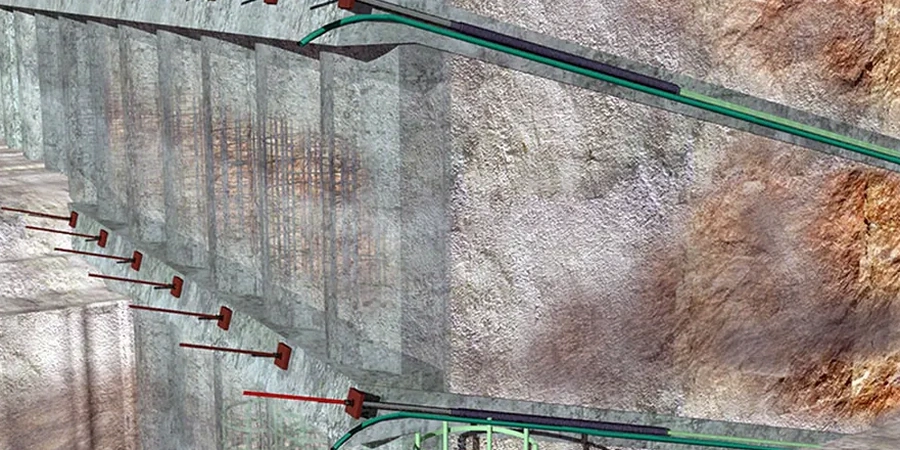
A commercial excavation on Rue Principale hit a layer of stiff glacial till at 4 meters. The shoring contractor needed tiebacks that could handle the lateral pressure without creeping. We designed the active anchor system with a bonded length reaching into the dense till below the weathered crust. The unbonded length kept the stressing zone well behind the failure wedge. Three verification tests confirmed less than 2 mm of movement at 133 percent of design load. For the passive side, we used fully grouted bars in the same till formation. The soil investigation with SPT drilling provided the input parameters for the anchor bond zone — N-values above 35 blows per foot gave us the confidence to push the bond stress to 150 kPa.
A properly designed anchor transfers load to competent ground beyond the active failure zone — the unbonded length makes that possible.
Methodology applied in Granby Quebec
Demonstration video
Risks and considerations in Granby Quebec
We use a hollow-stem auger or rotary-percussive rig to install the anchor borehole. In Granby's Champlain Sea clays, the hole can collapse if the casing is not advanced fast enough. The grout take is monitored with a flow meter. A sudden loss of pressure means the grout is escaping into a fissure or sand lens. We stop pumping immediately and switch to a thicker mix. For the stressing operation, a hydraulic jack with a calibrated gauge applies the load step by step. The dial indicator on the reference beam shows any movement at the anchor head. If the anchor creeps more than 1 mm per log cycle during the proof test, we reduce the bond stress and add bonded length. That decision comes directly from the data the field engineer reads on the gauge.
Our services
Our anchor testing and design support covers the full sequence from site investigation to lock-off:
Anchor Load Testing
Proof tests, performance tests, and creep tests on tieback and rock anchors. We use calibrated hydraulic jacks and digital dial indicators. Reports include load-displacement curves and creep plots.
Grout Mix Design Verification
Lab trial batches with local cement and water. We test flow cone, bleed, and compressive strength at 7 and 28 days. Mix adjustments for cold weather placement in Quebec winters.
Bond Zone Design Parameters
Correlation of SPT N-values and soil type to ultimate bond stress. We provide preliminary and final bond length recommendations based on site-specific ground investigation data.
Frequently asked questions
What is the difference between an active and a passive anchor?
An active anchor is stressed after grouting to apply a pre-determined load to the structure. A passive anchor is fully grouted but not stressed — it mobilizes resistance only when the ground moves. Active anchors control deformation better. Passive anchors are simpler and used where some movement is acceptable.
How much does anchor design and testing cost in Granby?
The cost ranges from CA$1,330 to CA$4,910 depending on the number of anchors, test type (proof or performance), and depth. A standard proof test on one anchor includes mobilization, load application, and a signed report with load-displacement data.
What soil conditions in Granby affect anchor capacity?
Granby has Champlain Sea clays in lower areas and glacial till on the slopes toward Mont Yamaska. The clay can creep under sustained load, so bond stress must be conservative. The till provides excellent bond but requires careful drilling to avoid hole collapse at the till-clay interface.
Do you test anchors in winter?
Yes. We use heated enclosures for the stressing equipment and monitor grout temperature during placement. The mix design includes admixtures for cold weather. Load cells and jacks are calibrated to operate down to -20°C.