Granby’s winter frost can reach 1.8 meters deep. That single fact reshapes every shallow foundation we design here. The silty clays left by the ancient Champlain Sea dominate the valley, while the morainal deposits near the Yamaska River behave entirely differently. A standard strip footing that works in Montreal often fails inspection in Granby if the frost protection and drainage aren’t dialed in from day one. In our experience, the key is linking the grain-size distribution of the bearing stratum directly to the frost-susceptibility classification before sizing the footing. We’ve seen too many projects where that step was skipped and the owner paid for it two winters later.
In Granby’s Champlain clay belt, bearing capacity is rarely the problem—frost heave and long-term settlement govern the footing design every time.
Methodology applied in Granby Quebec
Risks and considerations in Granby Quebec
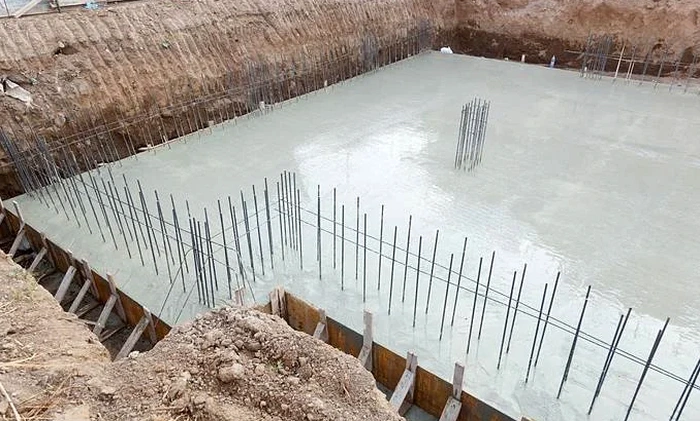
The machine we rely on most around Granby is a truck-mounted hollow-stem auger rig paired with a split-spoon sampler. It lets us punch through the crusty oxidized clay into the soft grey layer below without losing the sample. The risk we’re looking for is lenses of silt and fine sand trapped in the clay—little pockets that freeze hard and heave unevenly under a footing. If we hit water in those lenses, the short-term stability of the excavation wall becomes a safety concern during the pour. On two recent projects near the Yamaska, we had to switch from a standard spread footing to a deepened perimeter beam with rigid insulation just to get the bearing elevation below the active frost zone.
Our services
Each shallow foundation in Granby is accompanied by a design package that initiates with site investigation and concludes with stamped drawings suitable for municipal submission. Our involvement in recent local projects encompasses:
Bearing Capacity & Settlement Analysis
We run both drained and undrained bearing checks using site-specific Cu and friction angles. Settlement is calculated with Janbu’s method for compressible clays, targeting total settlement under 25 mm for conventional structures.
Frost-Protected Shallow Foundation (FPSF) Design
For unheated structures and additions, we detail the rigid insulation layout per CSA S501 guidelines. The goal is to keep the subgrade temperature above 0°C without extending the footing to 1.8 meters in every case.
Municipal Permit Drawing Package
We prepare the geotechnical report and stamped footing schedule that Granby’s building department requires for new residential and light commercial permits. This includes excavation notes, backfill specs, and frost protection details.
Quick answers
What is the typical cost for a shallow foundation design for a single-family home in Granby?
How deep do footings need to be in Granby to avoid frost heave?
The NBCC specifies a minimum 1.8-meter frost depth for the Granby region. Heated structures with continuous winter operation can sometimes use shallower frost-protected designs with rigid insulation, but an unheated garage or addition must reach the full 1.8 meters or use an engineered FPSF system.
Can you design a shallow foundation on the Champlain Sea clay without removing it?
Yes, in many cases. If the clay has an undrained shear strength above 40 kPa and the total settlement calculates under 25 mm, a wider strip footing with a mudmat works well. For weaker clays, we often recommend removing the top 1.5 meters and replacing it with compacted granular fill to create a stiff bearing platform.